- Heater knowledge
Features and applications of transparent film heaters | Wide range of applications from condensation and freezing to localized heating.
August 24, 2026
 Ryoko Fukai
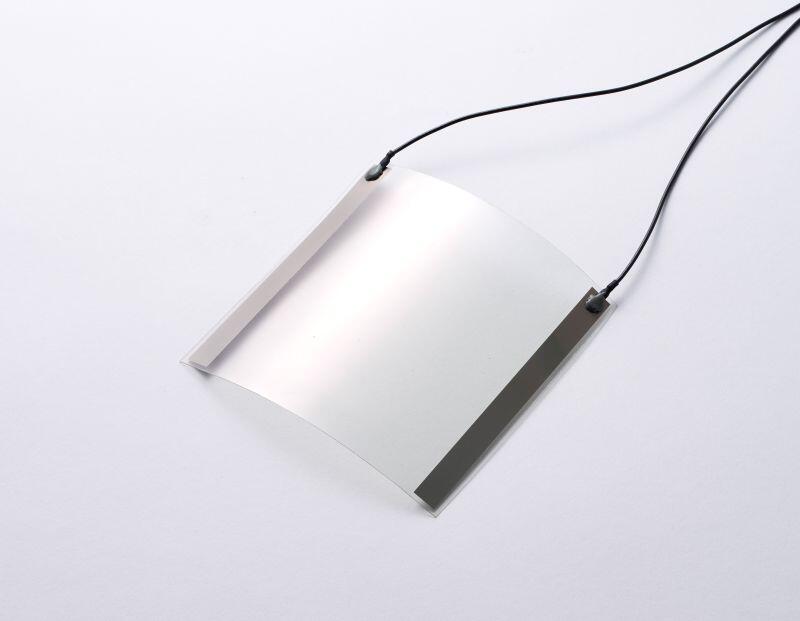
Transparent film heaters have a wide range of applications, including condensation prevention, freeze protection, and localized heating. For designers and site managers who want to add heaters without compromising aesthetics, or who want to prevent condensation and freezes while maintaining visibility, this is truly a long-awaited option.
ThreeHigh's transparent film heaters feature an ultra-thin design with a thickness of approximately 0.1 to 0.4 mm, achieving low resistance of approximately 10 to 12 Ω/sq. while maintaining high transparency in the visible light range. RoHS2 compliance also encourages adoption in fields with strict environmental regulations.
This article provides a clear and concise explanation of the mechanism, main applications, and selection criteria for transparent film heaters.
What is a transparent film heater? Three core features that expand its applications.
When considering implementation, there are three key points to keep in mind.
- Optical properties: The higher the transmittance and haze values, the clearer the view. ThreeHigh's transparent film heaters ensure high transparency in the visible light range.
- Electrical characteristics: The balance between sheet resistance and maximum output is crucial. ThreeHigh products have a low surface resistance of approximately 10-12 Ω/sq., allowing for efficient heat generation.
- Mechanical properties: Resistant to bending and temperature changes. It possesses high flexibility and bendability, making it suitable for application to curved surfaces.
How it heats up despite being transparent
ThreeHigh's transparent film heater has a structure in which a transparent conductive layer is formed on top of a PET film (50 μm or 125 μm) as the base material. When voltage is applied, Joule heat spreads uniformly across the entire surface.
The conductive layer generates heat across its entire surface, making it less prone to uneven heating in specific areas. Its extremely thin profile (less than 0.5mm) means it barely affects the appearance when applied.
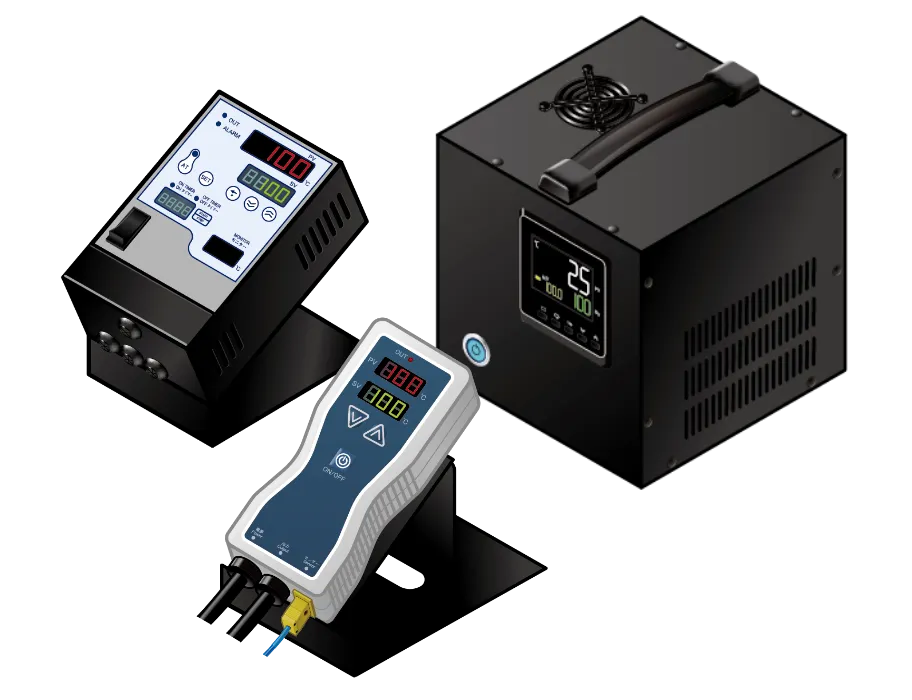
The transparent film heater itself does not have a self-temperature control function. When using it at high power density, be sure to use it in combination with an external temperature controller ( monoOne® series is recommended).
Specifications of the ThreeHigh transparent film heater
| thickness | Approximately 0.1-0.4mm (heater portion less than 0.5mm) |
|---|---|
| Base material | PET 50μm or PET 125μm |
| Heat-resistant temperature | Approximately 80-100°C (for PET substrates; varies depending on the insulating material) |
| Surface resistance | Approximately 10-12Ω/sq. |
| Compatible sizes | 50mm x 50mm to approximately A3 size (other sizes require consultation) |
| power density | Generally, a level of 0.8 W/cm² or less is optimal. |
| Compliant with standards | RoHS2 compliant |
| Order | We offer custom-made products starting from a single item. Standard products are also available for purchase through our online store. |
Introducing transparent film heaters 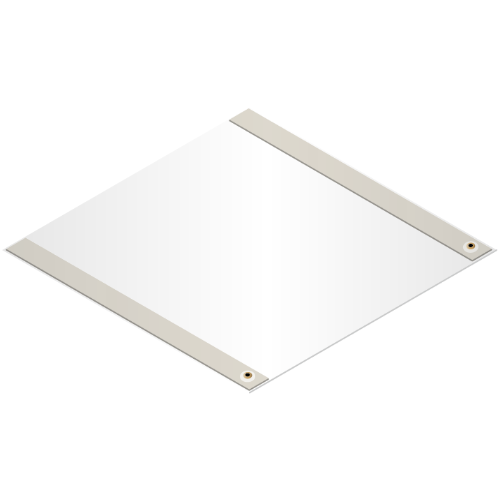
List of applications for transparent film heaters | Detailed explanation by field
It demonstrates its capabilities in any field where heating needs to be maintained while visibility is important.
[Application 1] Preventing condensation
By attaching a heater to the back of transparent glass or panels, the surface temperature is kept above the dew point, preventing condensation.
- Preventing condensation on windowpanes and constant temperature chamber glass.
- Glass surface of a refrigerated display case
- Viewing window/observation window of the device
- Bathroom mirror, smart window
[Use ②] Measures against freezing and snow accumulation
When glass, lenses, or sensor covers freeze or accumulate snow outdoors or in cold climates, it can lead to equipment malfunctions or reduced visibility. This can be prevented by preheating them with a transparent film heater.
- Snow accumulation prevention for outdoor surveillance camera lenses and covers
- Traffic light glass for cold climates
- Lens heaters for drones and optical equipment
- Defrosting of in-vehicle sensors (LiDAR and camera covers)
[Use ③] Preventing temperature drop and localized heating
In precision instruments and analytical equipment, performance and accuracy can be compromised if the temperature drops. Maintaining a constant temperature with a heater ensures stable operation.
- Heaters for analytical instruments in the biochemistry and medical fields
- Heating of test tubes and cylinders
- Constant temperature control of microscope stage
- Local heating of culture vessels
[Application ④] Other uses for transparent film heaters
- Anti-fog solution for AR/VR goggles
- Low-temperature startup support for industrial displays and outdoor signage.
- Maintaining visibility in special environments such as railways
Five key points to consider when choosing a transparent film heater for your specific needs.
1. Optical properties
We compare transmittance, haze, and chromaticity with initial values and changes over time. Depending on the application, it may also be necessary to check spectral characteristics data (ThreeHigh publishes spectral characteristics data and high-temperature, high-humidity environment test data).
2. Heat generation performance
The target temperature, heating time, and temperature uniformity within the surface are quantitatively checked. A power density of 0.8 W/cm² or less is generally recommended.
3. Durability/weather resistance
We will determine the degradation patterns due to bending tests, thermal shock, UV, and humid heat in advance. For outdoor applications, a combination with OCA (Optical Clear Adhesive) with UV protection is recommended.
4. Processability/Adhesiveness
We check the end face resistance after cutting and the compatibility with adhesives. Insulating materials (sealants) can be selected from PET film, overcoat paint, strong adhesive double-sided tape, silicone adhesive double-sided tape, etc., depending on the application.
5. Integration with temperature control system
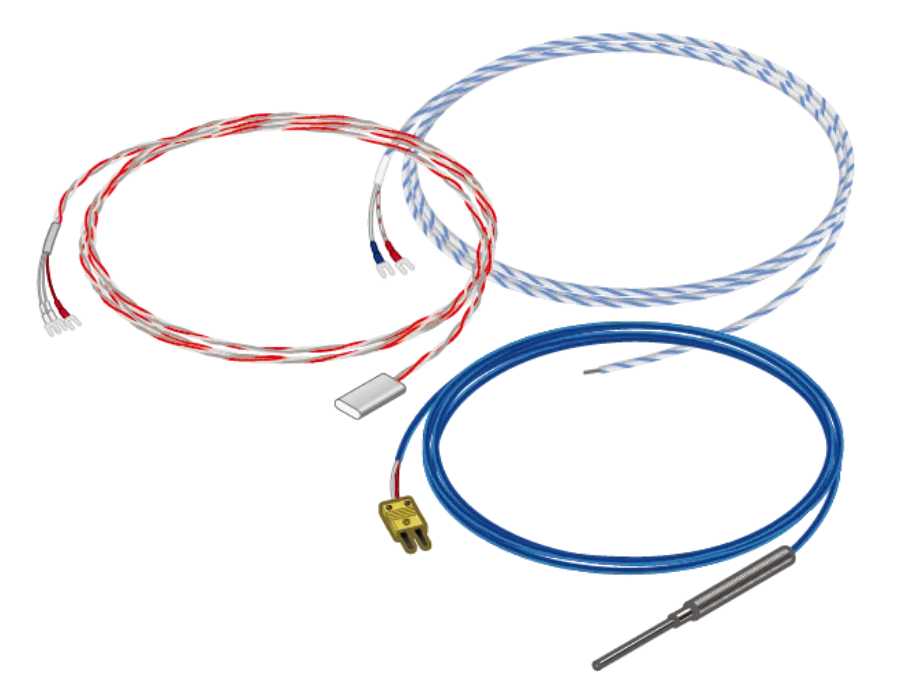
Since the transparent film heater itself does not have a self-temperature control function, a temperature sensor and temperature controller are required. ThreeHigh recommends the monoOne® series in combination with it.
Summary | We offer consultations tailored to your specific needs for transparent film heaters.
Transparent film heaters are surface heaters that cleverly solve the design challenge of "maintaining the original appearance while providing effective heating." Combining low resistance, high transparency, ultra-thinness, and high flexibility, they are widely used in applications such as condensation prevention, freeze protection, and localized heating.
We offer custom-made products starting from a single unit, and we will propose the optimal specifications tailored to your operating temperature, heating target, and installation environment. We welcome inquiries such as "Can this be used in this location?", so please feel free to Inquiry.
- Ryoko Fukai
- We are passionate about solving on-site problems and will readily travel anywhere in the country. With our inherent cheerfulness and perseverance, we propose the most suitable products for our customers. We want to bring energy to the workplace with both our technology and our smiles.